
This weekend I finished up the plus quilt I started a couple of weeks ago.
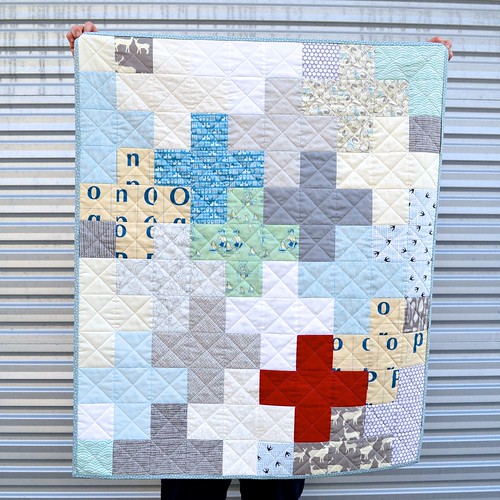
Simple quilting was the order of the day.
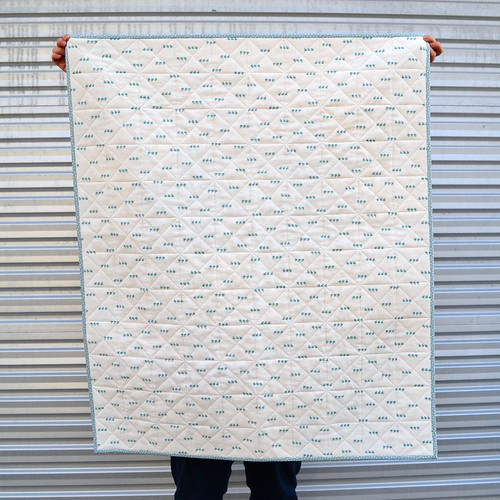
I backed this quilt with waffle fabric my dad bought in Japan.
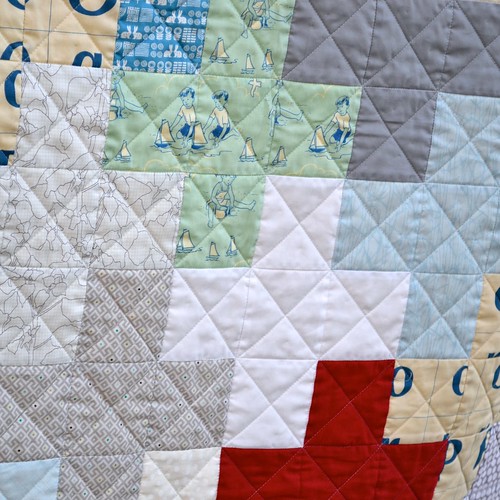
I also stitched in the ditch along all the seams as well as cross-hatching.
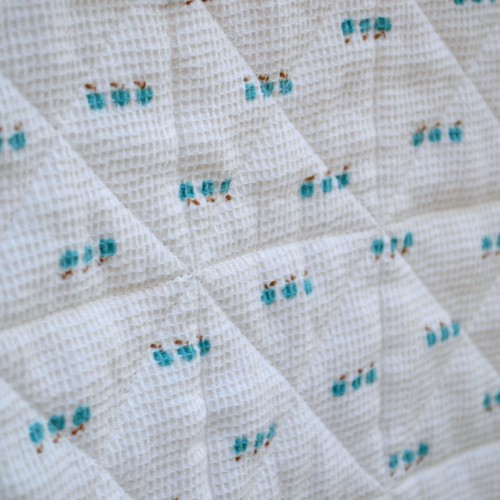
The waffle fabric gives this quilt great drape and it's lovely and soft and cuddly on the back. It's also made this quilt slightly crinkly already - I can't wait to wash this quilt and see what happens.
In case anyone else wants to try backing a quilt with waffle fabric, here are my tips:
- pre-wash the waffle fabric. I don't usually pre-wash my fabrics but I read somewhere that waffle shrinks a lot, so I pre-washed this waffle and also ran it through the dryer (I stitched the raw edges together using a long stitch before washing to prevent the whole thing from unravelling during this process). It did shrink a lot so that was very worthwhile.
- baste extra thoroughly. I used pins, which is my usual method of basting. I used more pins to baste than I usually would - two in each 3.5" finished square. I don't spray baste, so I don't have any particular tips there, but I wonder whether the woven texture of the waffle fabric might not be ideal for spray basting (I think it might absorb the glue more readily than more tightly woven fabrics). If someone experiments with spray basting waffle fabric, can they let me know?
- use a walking foot. Frankly, I always use a walking foot for straight line quilting and it is so worth the investment. Because the waffle has texture and is more loosely woven than quilting cotton, you really want to minimise the risk of it shifting around under your quilt and creating lumps or puckers. With a walking foot, your sewing machine feeds the quilt from both the top and the bottom which helps avoid this shifting.
- quilt a little more densely than you might otherwise. The risk with backing a quilt with slightly stretchy fabric like waffle (or minky) is that you can get saggy patches between your quilting lines. By having a smaller gap between the quilting lines, you minimise the amount of fabric that can stretch and create a saggy patch.
Quilt StatsIn case anyone else wants to try backing a quilt with waffle fabric, here are my tips:
- pre-wash the waffle fabric. I don't usually pre-wash my fabrics but I read somewhere that waffle shrinks a lot, so I pre-washed this waffle and also ran it through the dryer (I stitched the raw edges together using a long stitch before washing to prevent the whole thing from unravelling during this process). It did shrink a lot so that was very worthwhile.
- baste extra thoroughly. I used pins, which is my usual method of basting. I used more pins to baste than I usually would - two in each 3.5" finished square. I don't spray baste, so I don't have any particular tips there, but I wonder whether the woven texture of the waffle fabric might not be ideal for spray basting (I think it might absorb the glue more readily than more tightly woven fabrics). If someone experiments with spray basting waffle fabric, can they let me know?
- use a walking foot. Frankly, I always use a walking foot for straight line quilting and it is so worth the investment. Because the waffle has texture and is more loosely woven than quilting cotton, you really want to minimise the risk of it shifting around under your quilt and creating lumps or puckers. With a walking foot, your sewing machine feeds the quilt from both the top and the bottom which helps avoid this shifting.
- quilt a little more densely than you might otherwise. The risk with backing a quilt with slightly stretchy fabric like waffle (or minky) is that you can get saggy patches between your quilting lines. By having a smaller gap between the quilting lines, you minimise the amount of fabric that can stretch and create a saggy patch.
Pattern: made up as I went along plus quilt pattern
Finished Size: approx 35" by 42"
Fabric: many
Backing: waffle
Binding: unknown (no details on the selvedge)
Pieced and quilted by: me

